
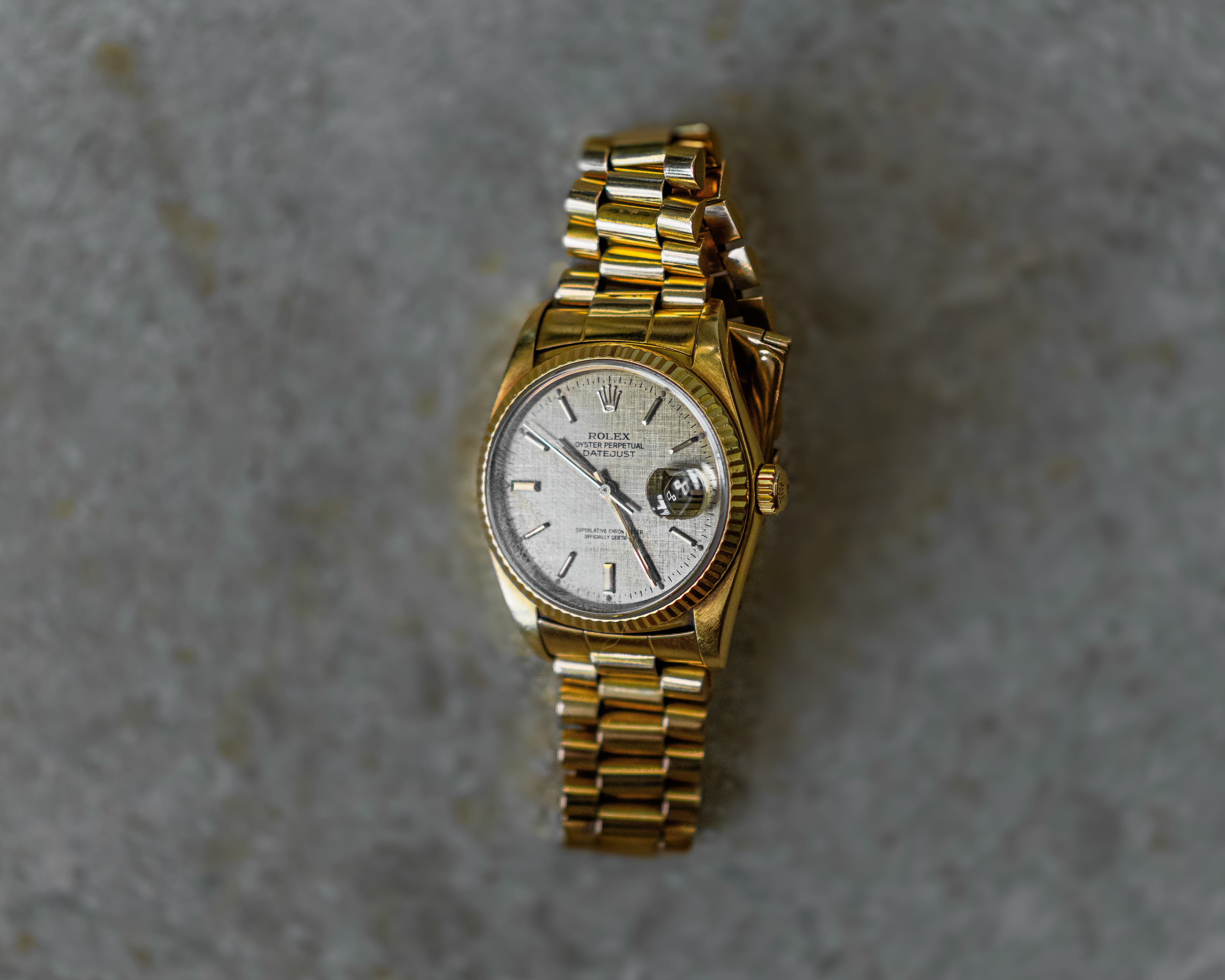
In one of my parents’ wedding photographs, my father looks both nervous and proud. On his wrist, a flash of yellow gold anchors the frame. The watch is an 18k Rolex Datejust with a fluted bezel and linen dial, given to him by my maternal grandfather on his wedding day. I could not yet tell the time when I first noticed it, but it became my first idea of what a “real” watch could be: not simply a machine or luxury object, but a vessel for taste, memory, and family lore.
That seems like the right place to begin.
My name is Jason. On Instagram, you may know me as @seoulwatchguy, and my writing has appeared in SJX Watches, Time+Tide, and WatchTime USA. Since leaving my last role in watch media a few months ago, I have missed having a place to explore the parts of collecting that do not fit neatly into release coverage or a conventional review: why certain watches stay, why others leave, and why a detail that looks insignificant on a specification sheet can determine the fate of an otherwise excellent watch. This blog is that place.
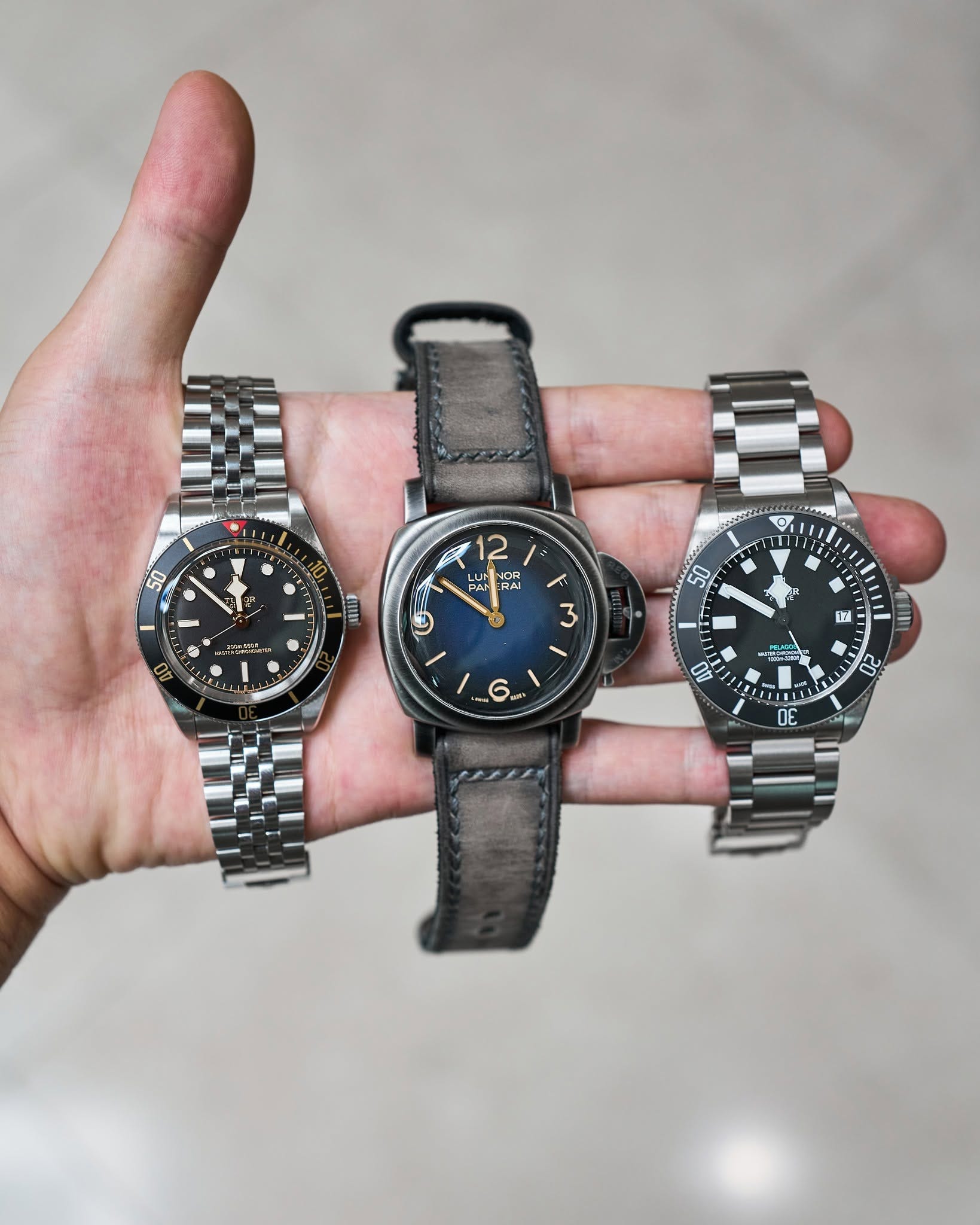
So far, 2026 has brought heavy churn to my watch box. Three watches remain in my personal collection today: a second-generation Tudor Black Bay 58, a Tudor Pelagos Ultra, and a Panerai Luminor Venticinque PAM02025. The Datejust still belongs to the family, but it explains why any of the other three matter to me. Not one of these watches stayed because it occupies the highest rung of some imaginary hierarchy. Each stayed because it resolved a tension I could no longer ignore.

Tudor Black Bay 58
I bought and sold the original Black Bay 58 three times.
The attraction was never difficult to explain. Its 39mm case, gilt accents, snowflake hands, aluminum bezel insert, and matte, vintage-inspired finish felt distinct from the polished cases and glossy ceramic bezels that dominate the modern luxury dive-watch category. For a long time, if you wanted that combination of compact proportions and subdued surfaces, the most obvious choices seemed to be either a neo-vintage, five-digit Rolex or the Black Bay 58. Tudor’s historical ties to Rolex supplied context, but the watch had more than enough character to stand on its own.
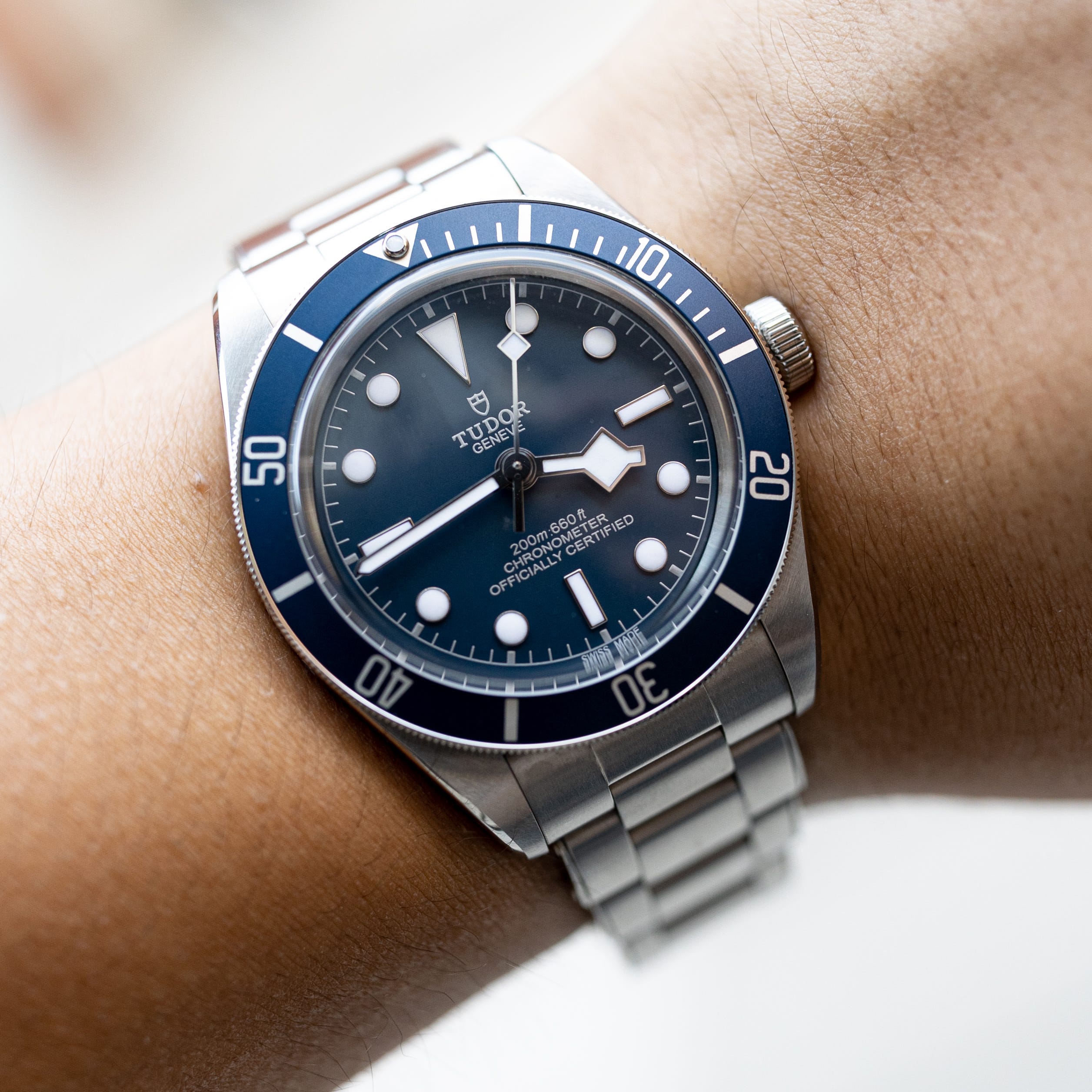
The reason I kept selling it was equally simple: I could not get past the faux rivets on the bracelet. Artificially aged lume can work when it serves the whole design. The decorative rivets did the opposite for me, making an otherwise convincing watch feel less honest. I tried aftermarket Jubilee- and Oyster-style bracelets, but neither was comfortable enough to become a permanent answer. Comfort is not a detail I am willing to negotiate. A watch can look perfect in a photograph and still fail over the course of an ordinary day.
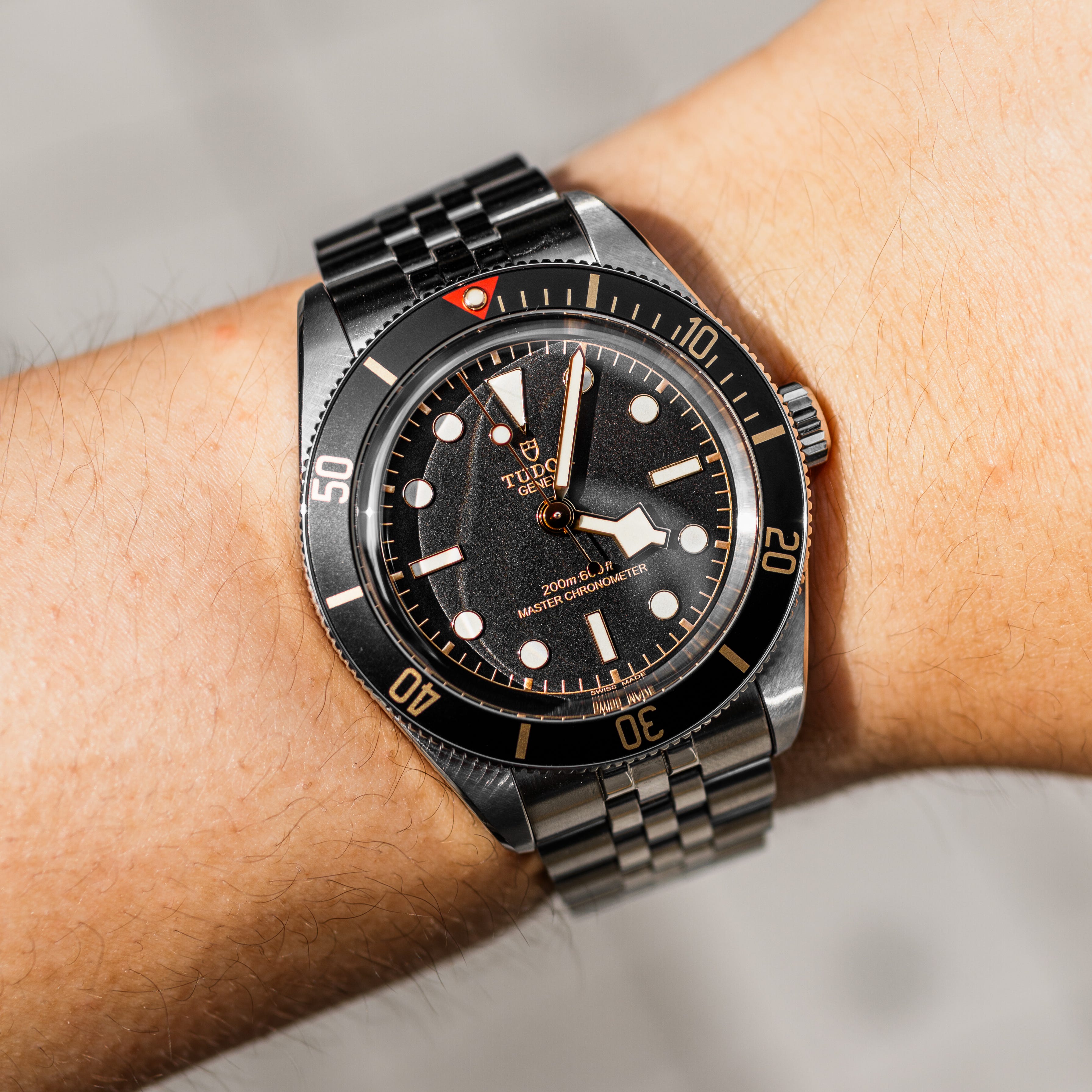
In 2026, a century after “The Tudor” trademark was registered, the brand marked the occasion with a broad program of new releases and updates, including a revival of the historical Monarch name. Against that background, the revised black Black Bay 58 was easy to read as an incremental change. It retained the 39mm diameter and 200-meter water resistance, but adopted a redesigned case measuring 11.7mm thick. Inside, the METAS-certified manufacture caliber MT5400-U offers a 65-hour power reserve. The dial text was reduced to two lines, while the hour and minute hands, lollipop seconds hand, bezel, crown, and case profile were all subtly reworked. Most important for me, the watch became available on an articulated five-link bracelet with Tudor’s tool-free T-fit clasp—and no faux rivets.
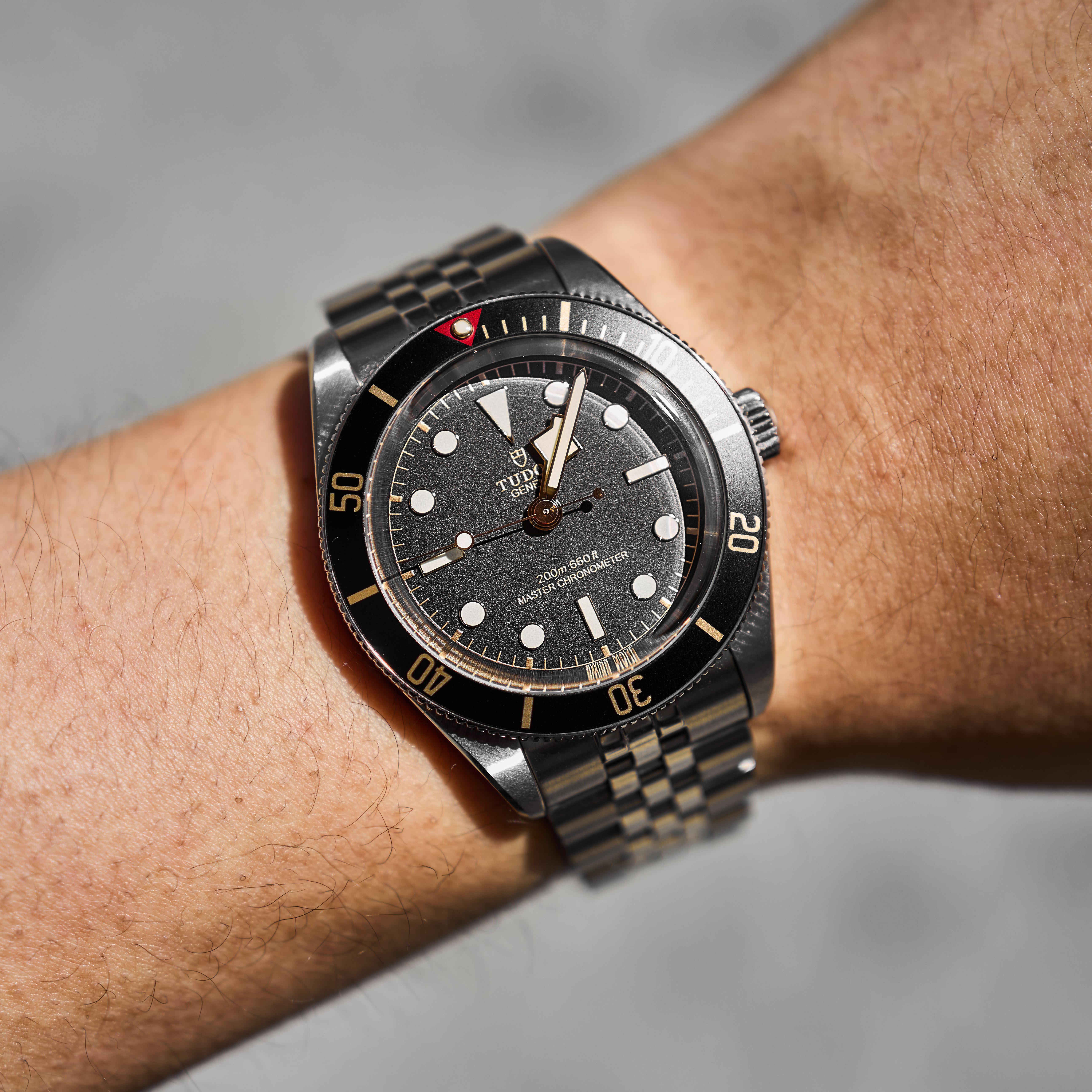
No single change transforms the watch. Together, they transform the experience of wearing it. The cleaner dial restores space, the slightly slimmer case settles more naturally, and the five-link bracelet gives the Black Bay 58 the comfort and refinement its proportions always promised. T-fit also removes the old choice between wearing the bracelet slightly too tight or slightly too loose.
The new Black Bay 58 is not a reinvention, and that is precisely why it works. Tudor did not replace the original idea. It removed the details that had kept me from living with it. Sometimes a successor does not need to become a different watch; it only needs to eliminate the reasons you kept selling the old one.
Tudor Pelagos Ultra
The Pelagos Ultra made the opposite argument. Where the Black Bay 58 draws people in with restraint, the Ultra announces itself with a 43mm-by-14.5mm case made from Grades 2 and 5 titanium, a helium escape valve, and ISO-tested water resistance to 1,000 meters. Its METAS-certified MT5612-U movement runs for 65 hours, while enlarged markers and two colors of lume turn legibility into something close to overkill. None of that sounded compatible with my 7.1-inch wrist.
When the Pelagos Ultra reached Tudor boutiques in South Korea, I went to see it out of curiosity rather than intent. I had already dismissed it on paper. A 43mm professional dive watch seemed destined to be capable, impressive, and completely wrong for me.
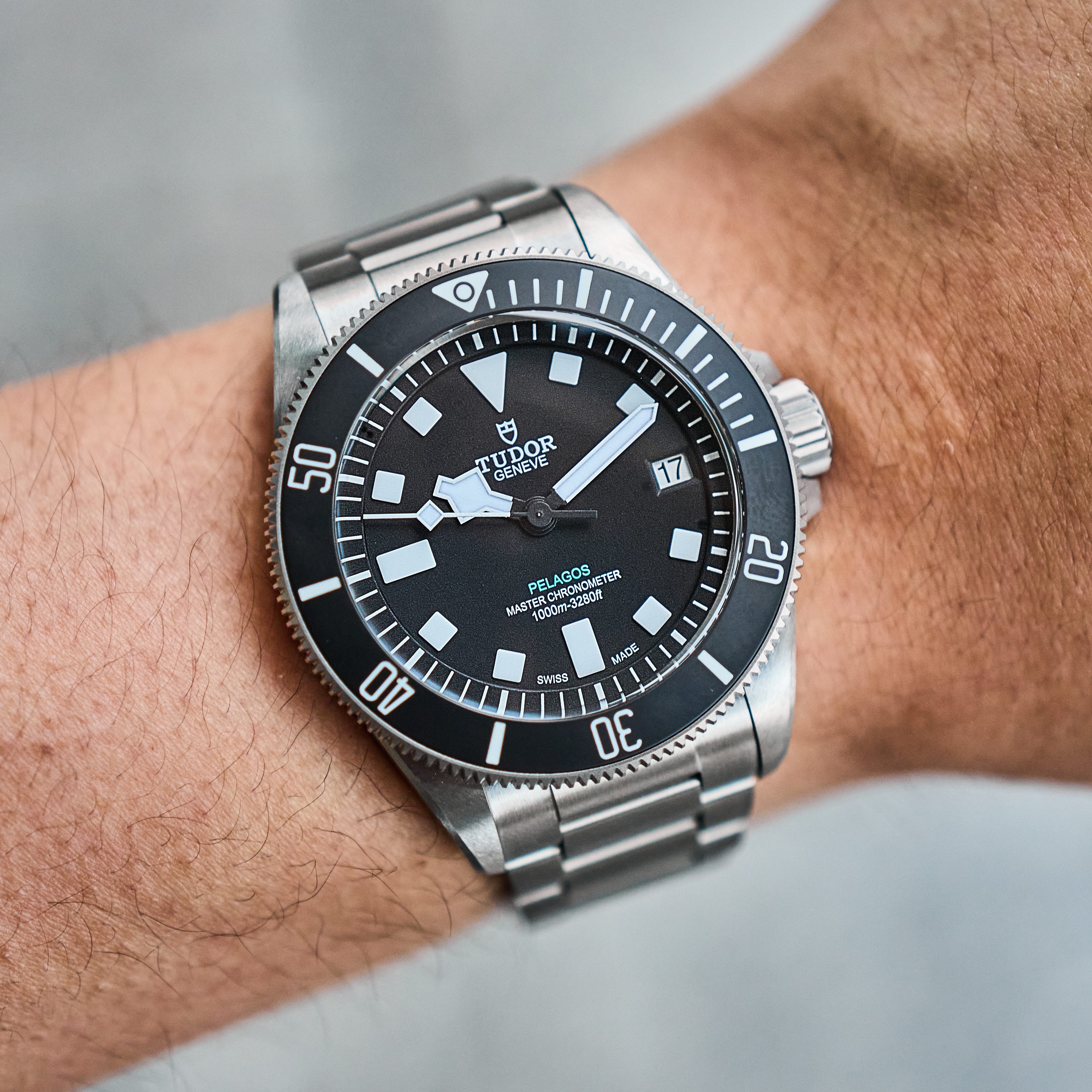
Then I put it on.
The Ultra wears far better than its diameter suggests because the lugs curve down and settle around the wrist instead of holding the case flat above it. Titanium keeps the weight under control, while the shape distributes what remains evenly. It is not a small watch pretending to be smaller. It is a large watch whose proportions have been properly considered. Size is a measurement. Bulk is a result.
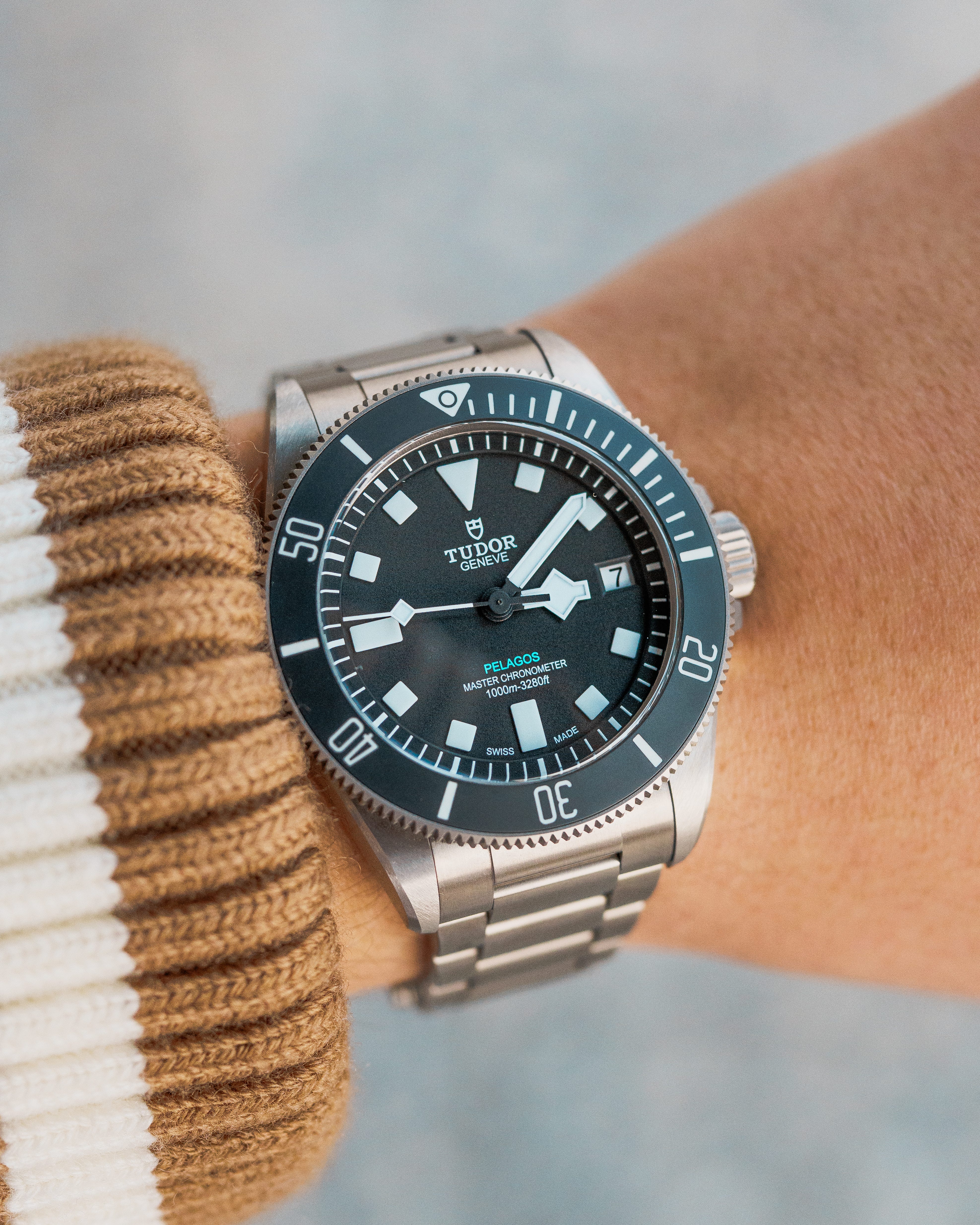
The dial made the stronger case over time. Its matte black surface has a fine-grained texture, and the sky-blue Pelagos signature introduces just enough color without breaking the tool-watch character. The snowflake hands and blocky markers look entirely at home at this scale. The three-link titanium bracelet also avoids the faux rivets that had repeatedly driven me away from the original Black Bay 58, while combining T-fit adjustment with a proper diver’s extension.
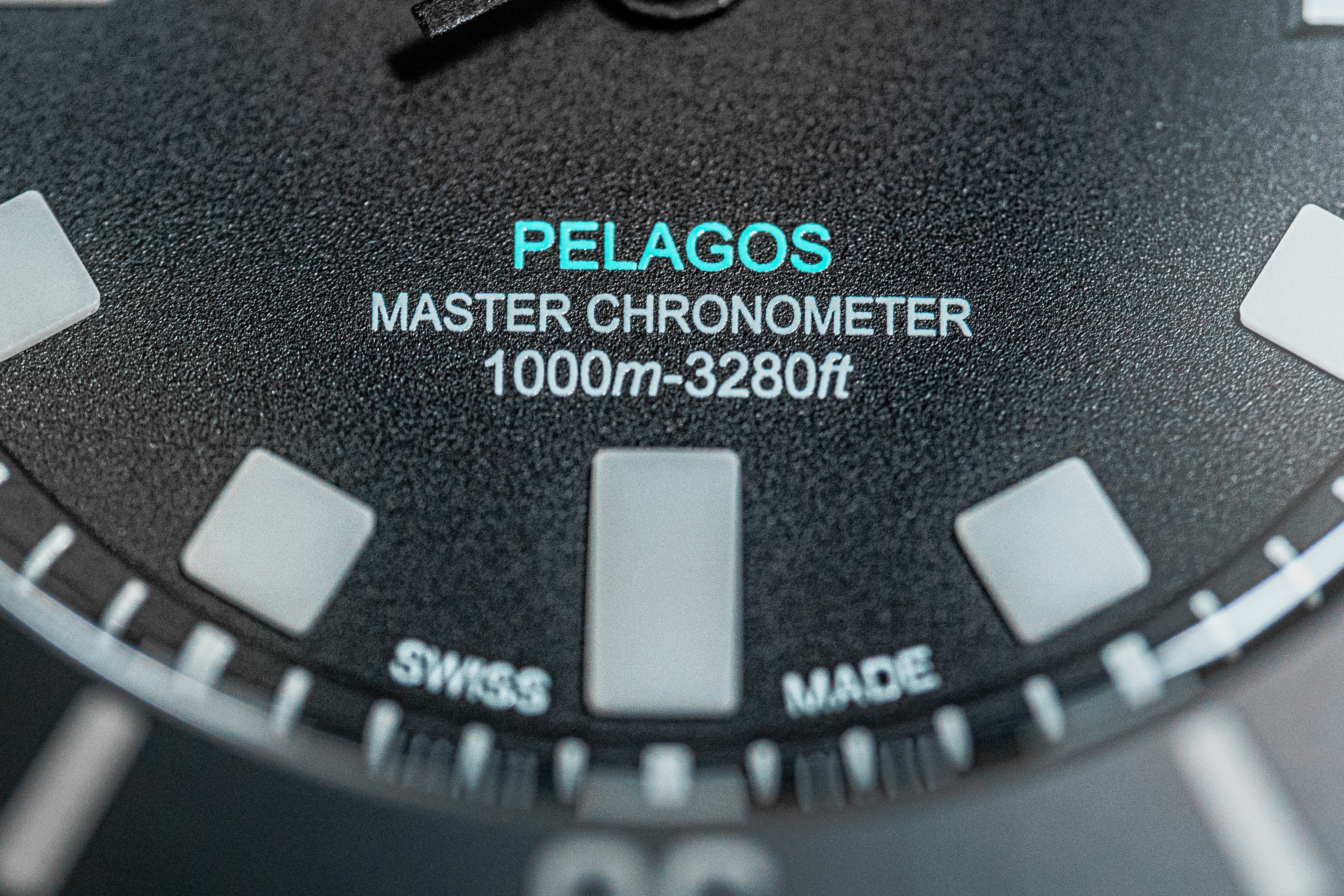
I did, in fact, sell my first Pelagos Ultra. The decision had less to do with the watch’s design than with the bracelet pulling at my wrist hair often enough to become irritating. Later, wearing my Black Bay 58 with its clasp positioned slightly farther under the wrist showed me how much a small change in fit could help. More tellingly, once the Ultra was gone, I missed it. I eventually sold my Panerai Luminor 8 Days GMT PAM00233 to bring the Tudor back.
That is the clearest verdict I can give it. Some watches make their strongest argument only after they leave. The Pelagos Ultra did.
Panerai Luminor Venticinque PAM02025
Panerai leaves little room for indifference. The cases are bold, the proportions uncompromising, and the crown-protecting bridge announces itself before almost anything else. You either recoil from the entire proposition or eventually understand why owners speak about Panerai as though it were a category of its own.
My own descent into that category was fast. After more than a decade of collecting watches from familiar names such as Rolex, Tudor, and Omega—with the occasional oddball to keep things interesting—I bought a Luminor PAM00915. It was meant to be one experiment. Within a month, I had also bought a Radiomir Otto Giorni.
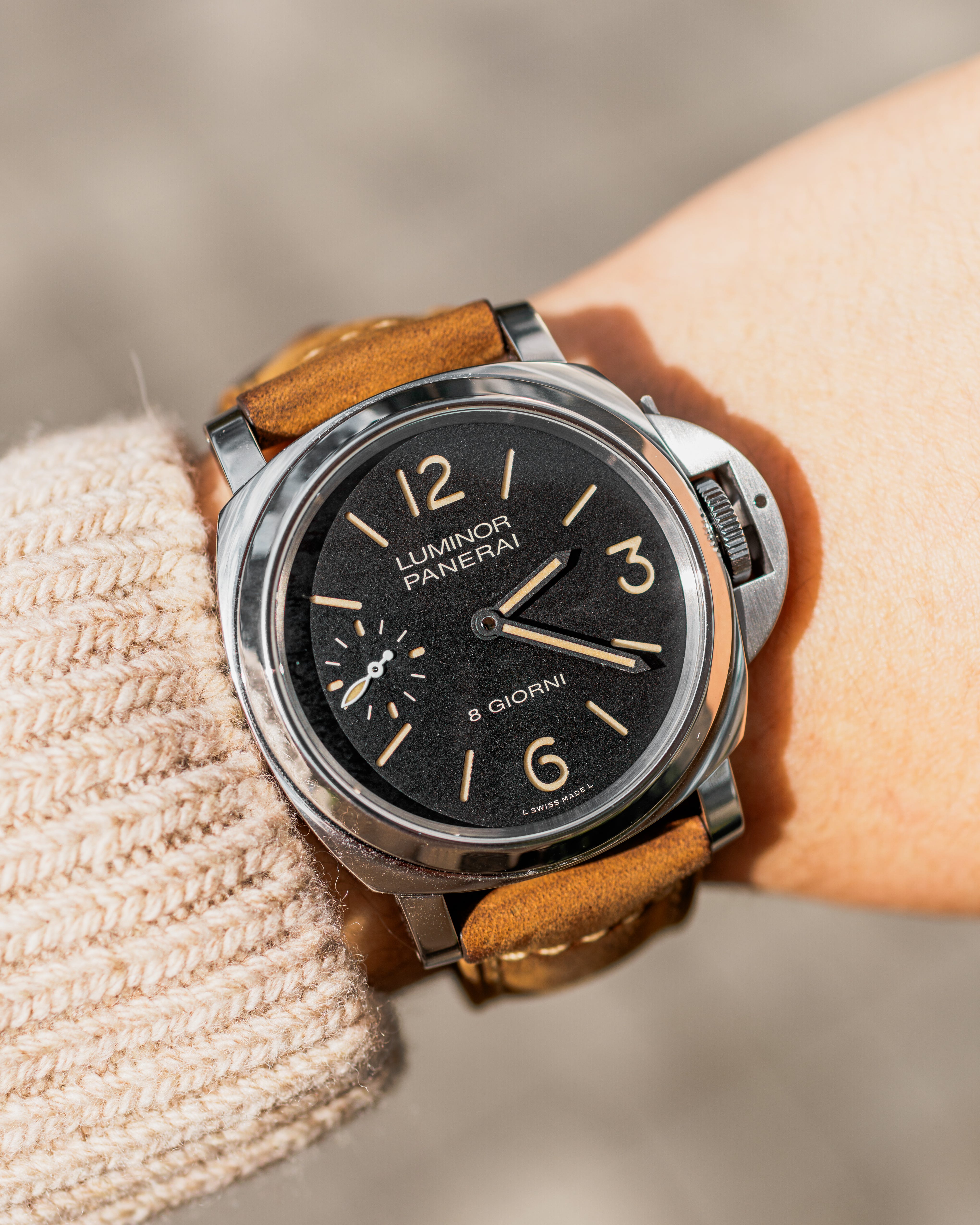
The two watches presented inverse compromises. The Luminor wore remarkably well, its cushion case sitting flat and planted while the crown guard kept the crown away from my wrist. But its fully polished case made an already assertive design feel too shiny for the way I dress and move through an ordinary week. The Radiomir solved that aesthetic problem with a dark Brunito steel case and brown fumé dial, yet its oversized crown dug into my wrist often enough to change how frequently I wore it.
One wore right but looked wrong. The other looked right but hurt.
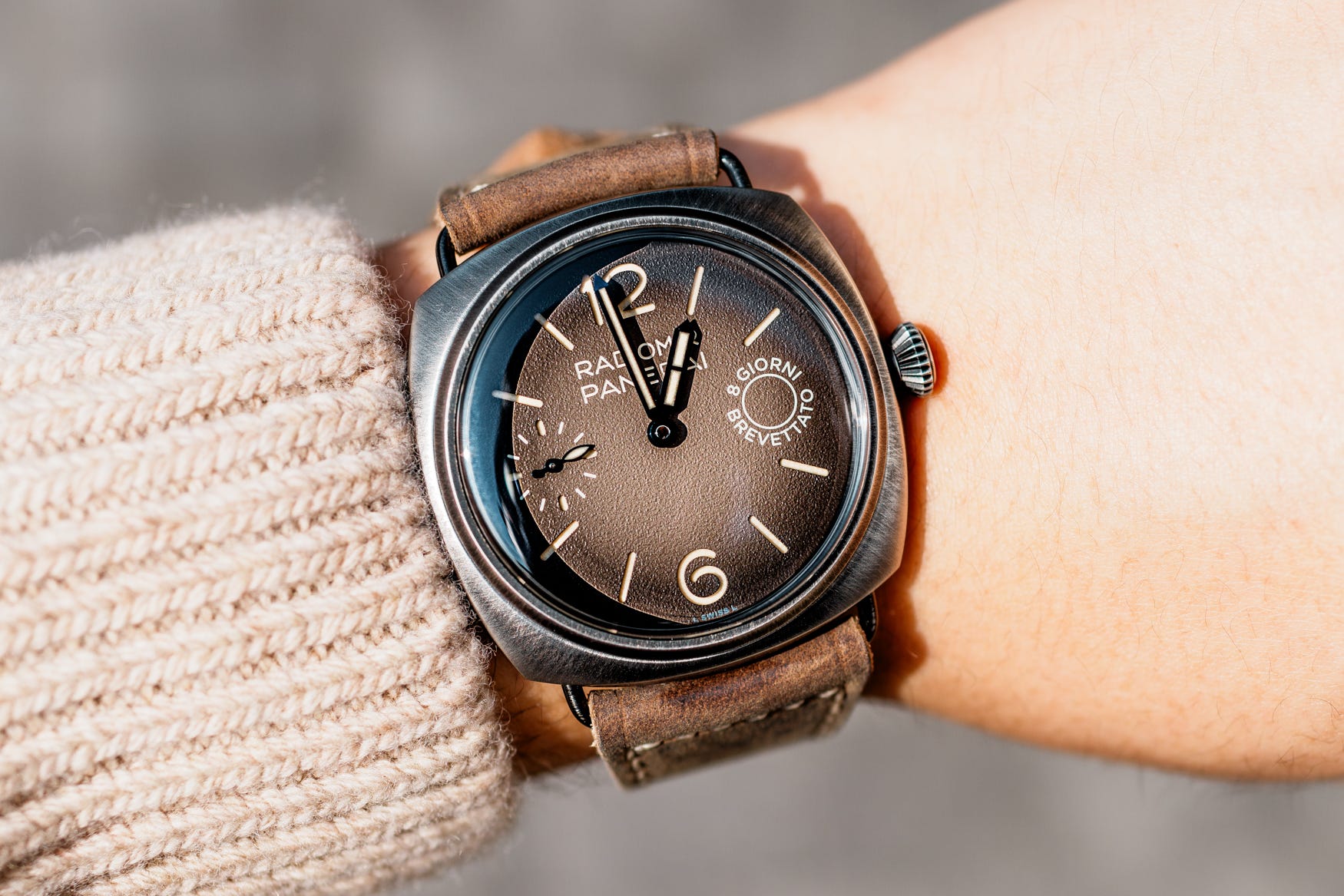
That tension sent me searching for the comfort of a Luminor combined with the Radiomir’s Brunito finish and the visual depth of a fumé dial. Panerai’s catalog is built on variations, but that exact combination proved surprisingly elusive. The one reference that kept resurfacing was the Luminor Venticinque PAM02025.
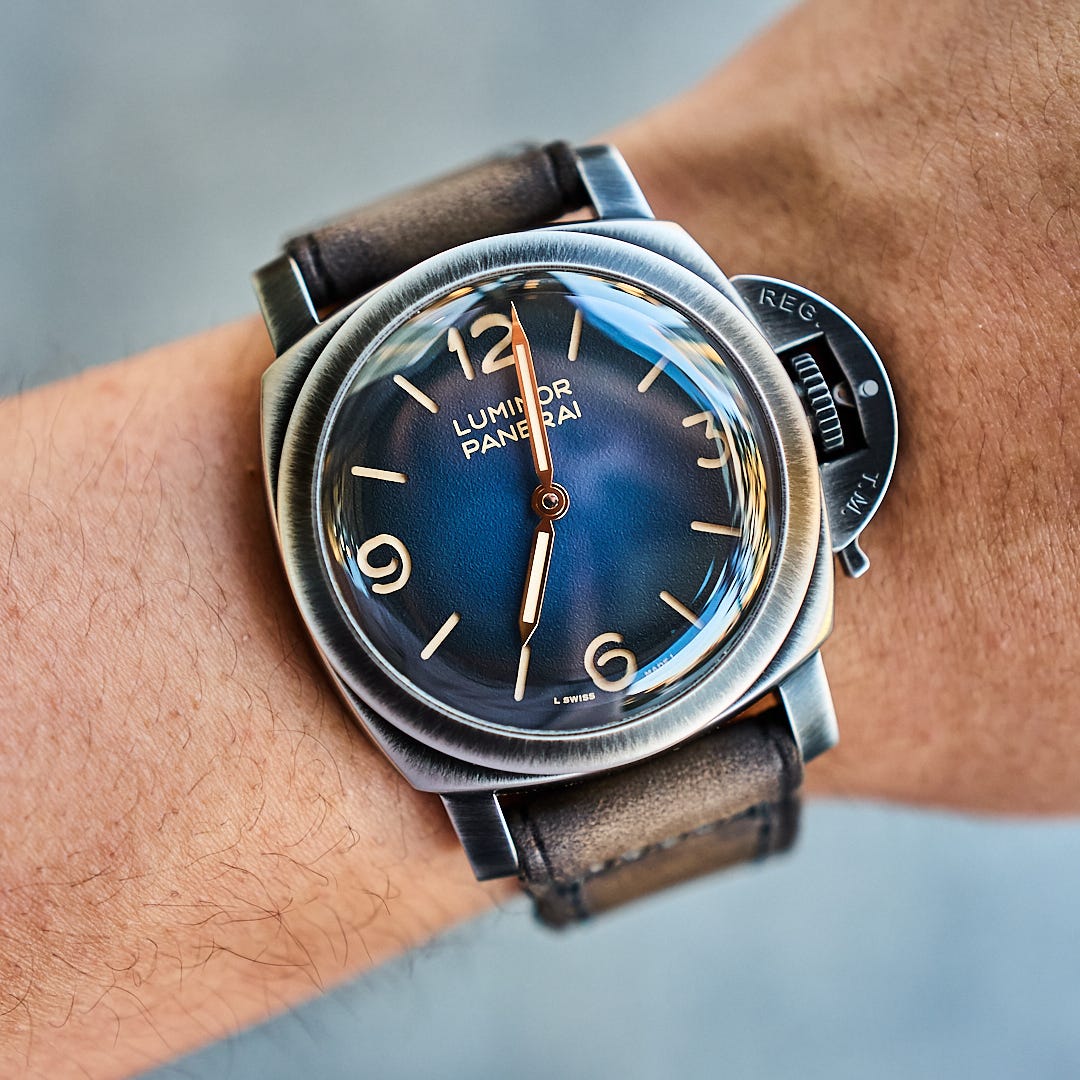
Created for the 25th anniversary of the Paneristi community and limited to 1,000 pieces, the PAM02025 uses a 44mm Brunito steel Luminor case, a blue gradient sandwich dial, and a heavily domed sapphire crystal that recalls the distortion of vintage Plexiglas. I registered my interest at the boutique and received the allocation call three or four months later.
The Brunito finish is the foundation of the watch. Panerai applies a dark PVD coating to the steel and then reworks it by hand to create an uneven, aged effect. It is not stealthy in the clinical manner of flat black ceramic, nor does it ask to remain pristine like a polished steel case. It has presence, but it also looks ready to record wear.
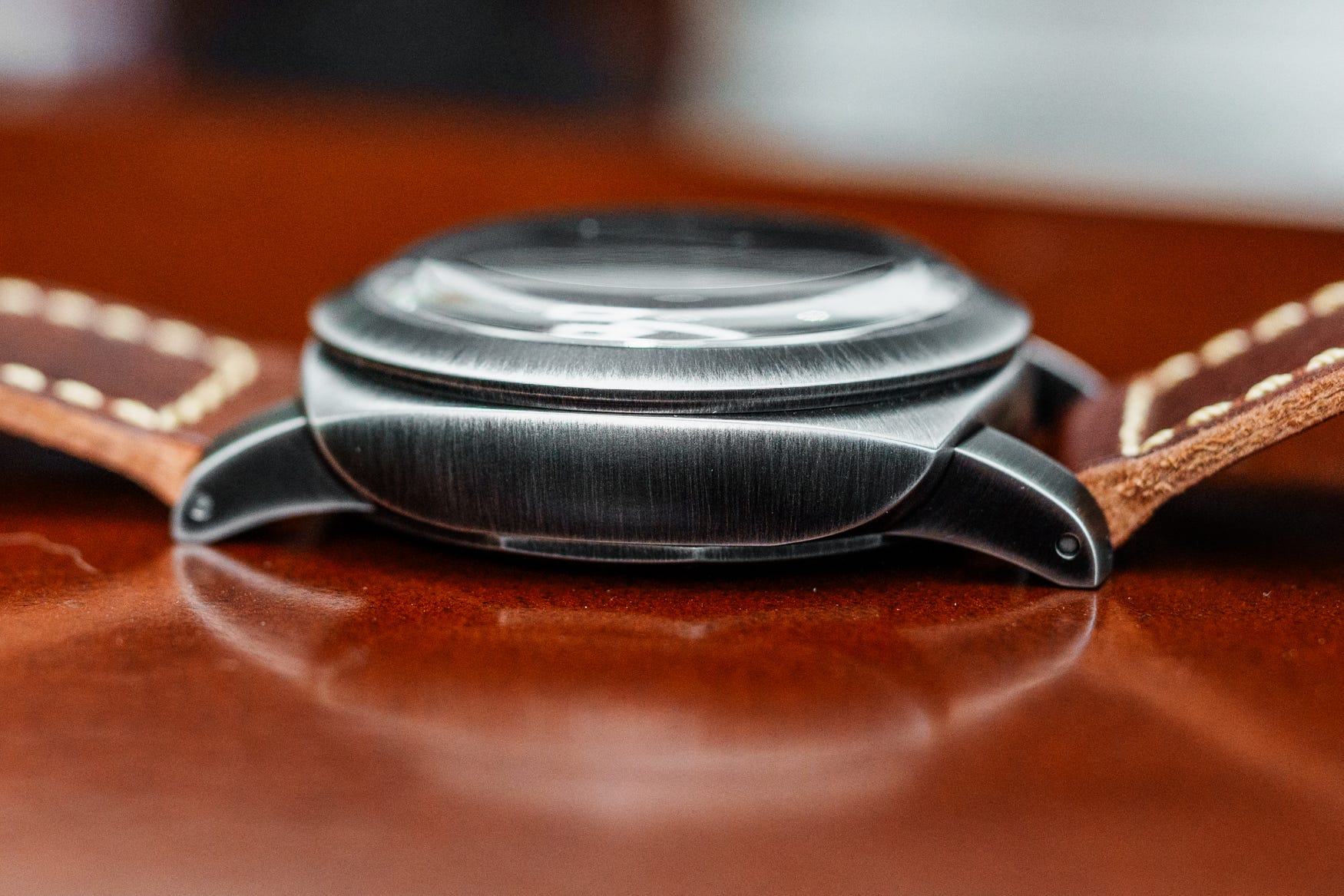
The crystal and dial make the finish feel deliberate rather than cosmetic. The pronounced dome softens the Luminor’s broad planes and gently distorts the dial at oblique angles. Beneath it, the blue fumé surface runs from a rich, inky center to near-black at the edge. Together with the sandwich construction and beige luminous material, it adds depth without compromising the clarity on which a Panerai dial depends.
The smoked sapphire caseback reveals the hand-wound P.6000. It is a straightforward caliber—hours, minutes, stop seconds, a 21,600-vph frequency, and a three-day power reserve—presented beneath broad, horizontally brushed metallic bridges. The specifications matter, but the real achievement is cohesion.
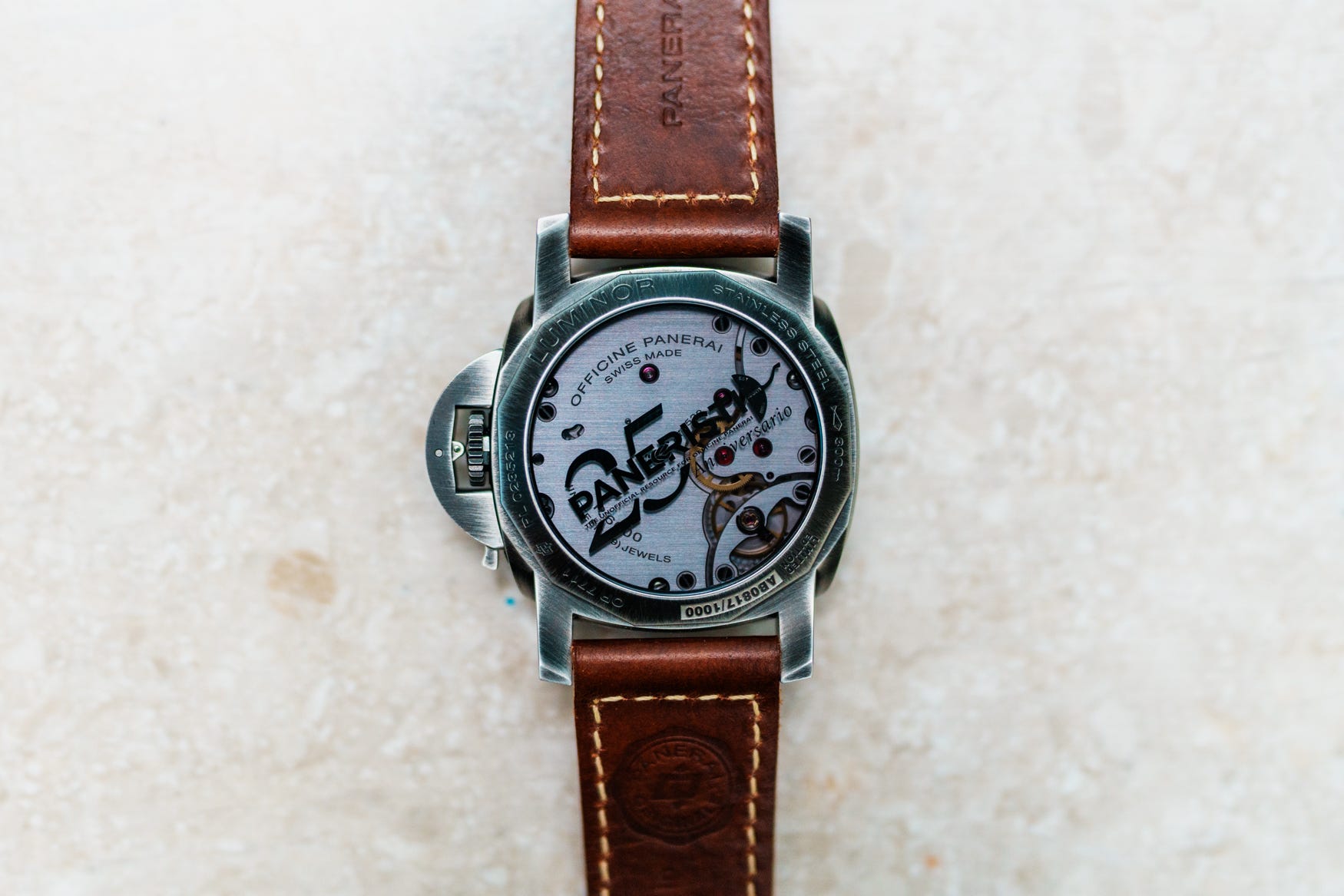
Most importantly, the PAM02025 solved the ergonomic problem that began the search. The Luminor bridge prevents the crown from becoming a pressure point, making the watch comfortable despite its scale. It gives me the finish and dial that made the Radiomir special without asking me to tolerate the reason I stopped wearing it.
It is not a compromise between my first two Panerais. It is the Panerai I had been trying to assemble in my head.
YG Rolex Datejust Ref. 1601
That brings me back to the flash of yellow gold in my parents’ wedding photograph.
The Datejust originally belonged to my maternal grandfather. He died while I was still in elementary school, but stories about him have always traveled freely around our dinner table. According to our family history, he built his life in public service and business, serving as South Korea’s minister of foreign affairs during the Park Chung-hee era before later holding a senior role at Daewoo. My father remembers that he owned several Rolex watches over the years, not as an enthusiast in the modern sense, but because they were dependable objects suited to the pace of his life.
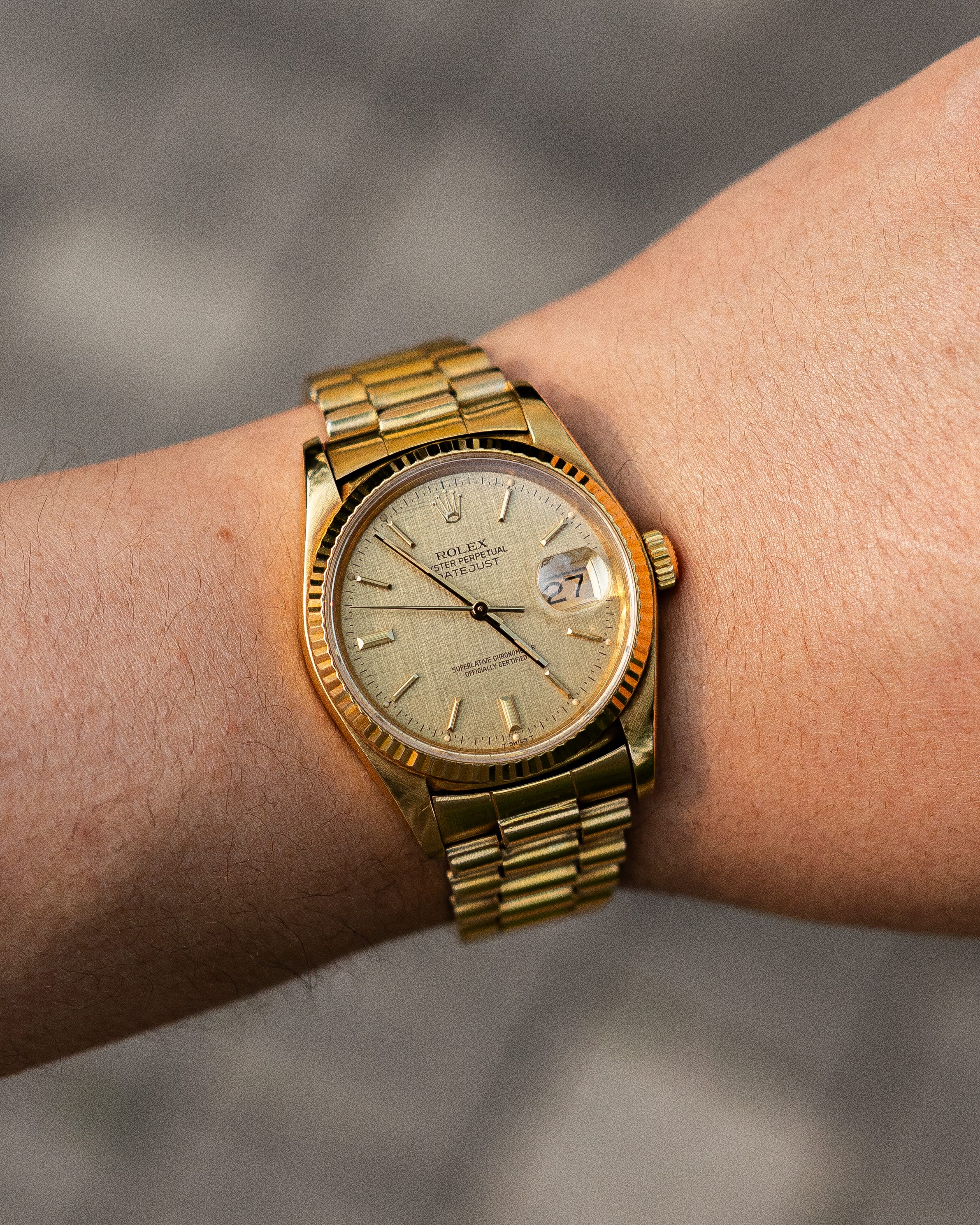
The precise circumstances in which he acquired this Datejust have been lost. In South Korea in the 1980s, however, a solid-gold Swiss watch was a far less ordinary purchase than it is today. My grandfather traveled often and had the means to buy one, but what remains is not a receipt or a boutique story. It is the decision to give the watch to my father on his wedding day, following a practice common in Korean families of exchanging significant gifts between the two sides of a marriage.
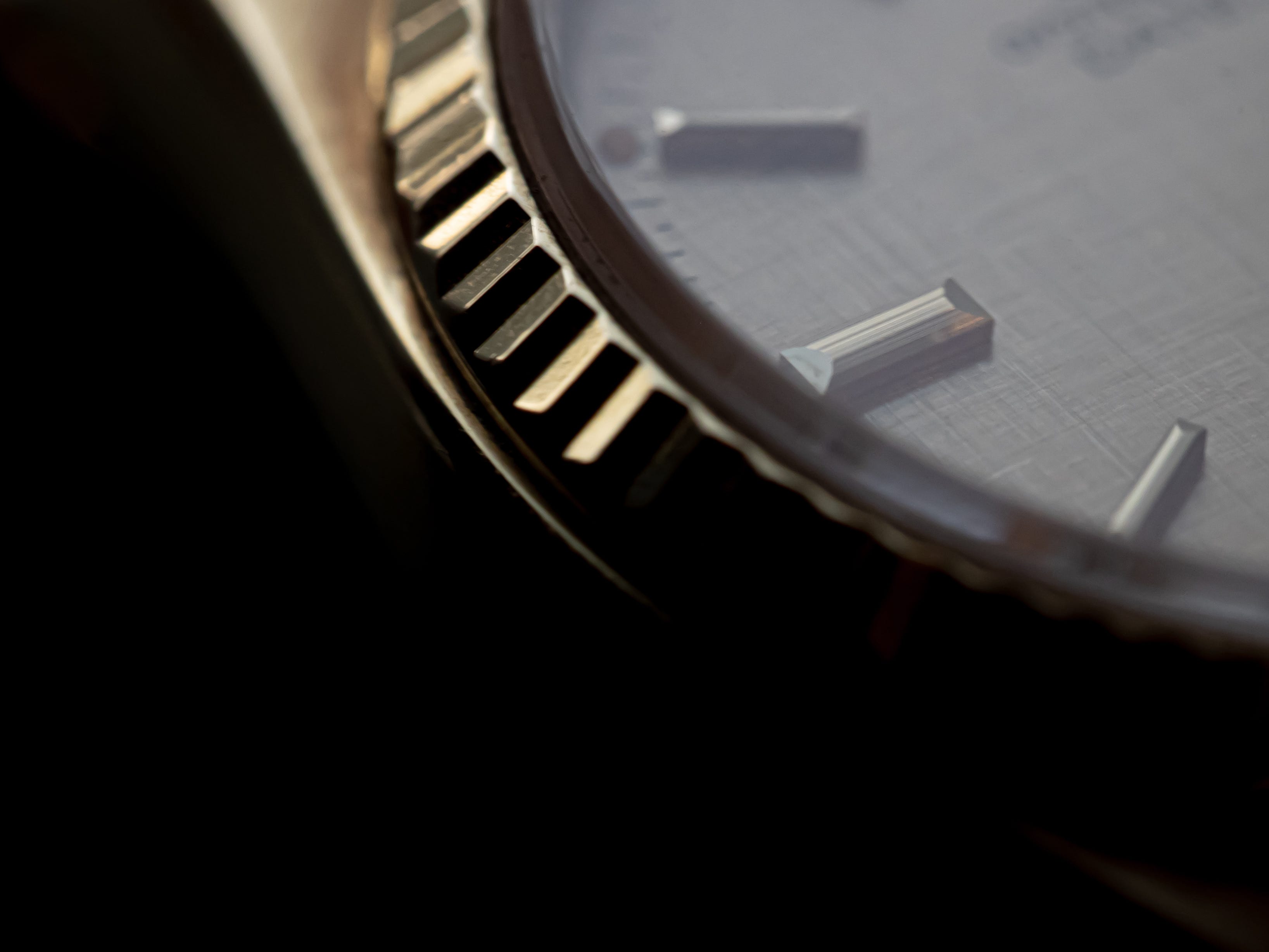
The watch itself is an 18k yellow-gold Datejust with a fluted bezel and a linen dial. That dial is the detail I remember most clearly from childhood. Its woven texture changes with the light, producing fine relief and tiny shadows that photographs rarely capture. It was my first lesson that a watch is not simply a color or a case shape. Personality emerges from accumulated decisions about proportion, texture, and surface.
Then there is the bracelet.
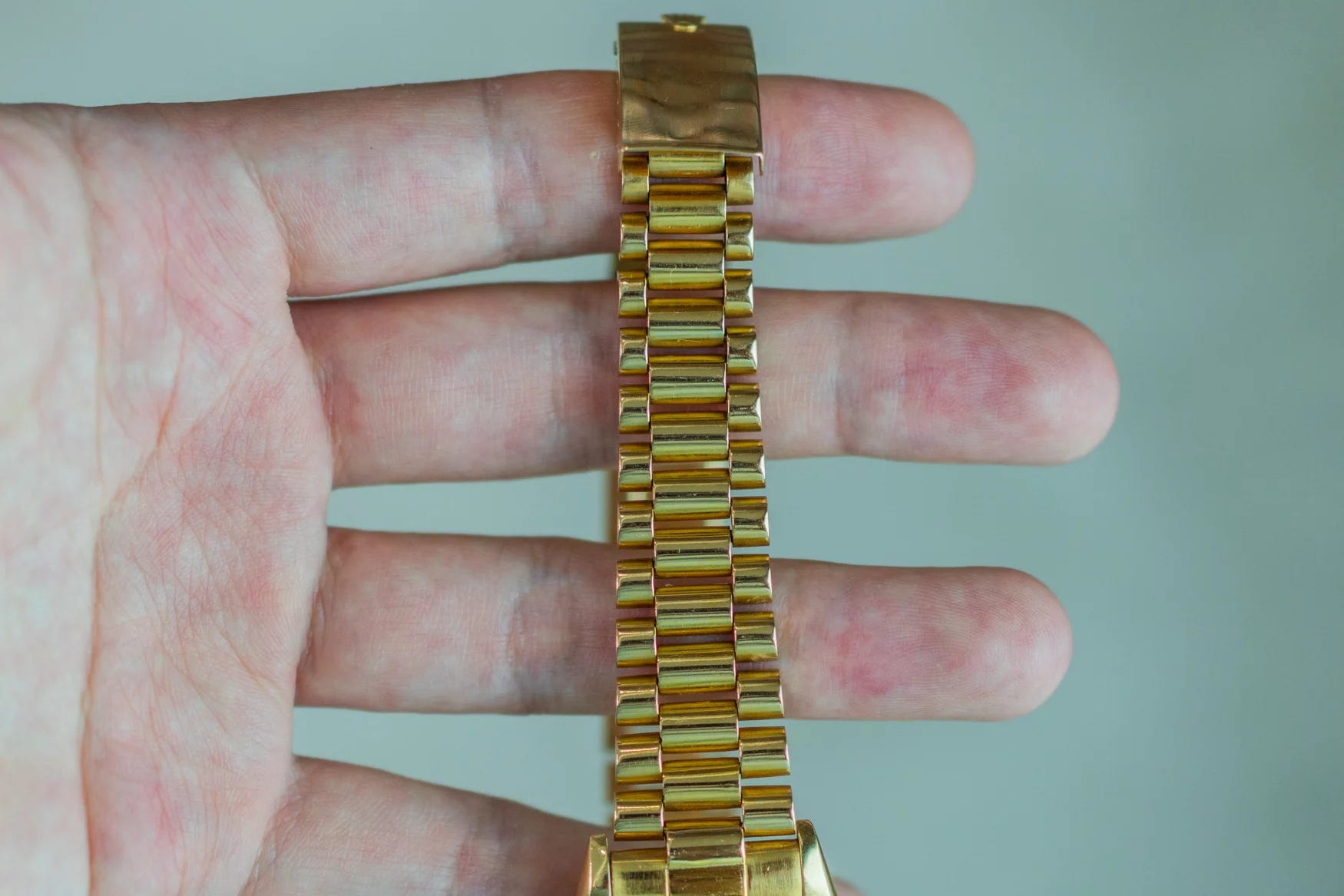
When my father received the watch, it was fitted to an aftermarket yellow-gold President-style bracelet. Rolex created the President bracelet for the launch of the Day-Date in 1956 and has also used it on precious-metal Datejust models. The unusual part here is not the basic pairing of that bracelet shape with a Datejust. It is that this particular bracelet was not supplied by Rolex—and that no one in the family knows why my grandfather chose it.
My father, who does not obsess over watches the way I do, can offer only possibilities. Perhaps my grandfather preferred the visual weight of the semicircular links. Perhaps he associated the design with status and felt that a wedding called for something more imposing. Perhaps it was simply what the jeweler could provide in time. I wish I could ask him. I cannot.
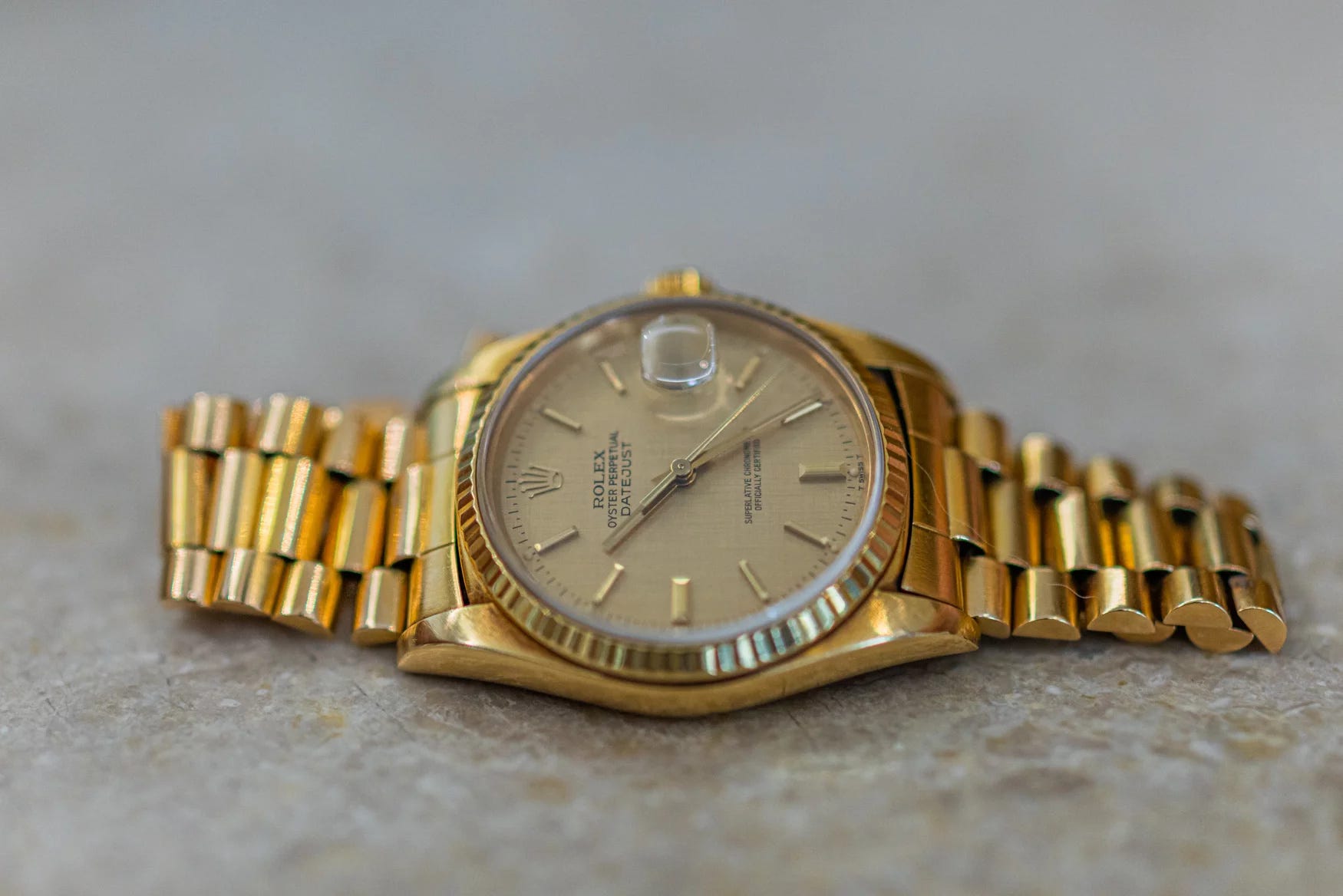
As I grew older and fell deeper into watches, that unexplained choice changed the way I thought about originality. Collectors often discuss authenticity as though the objective were to fix a reference in amber: the correct dial, bracelet, clasp stampings, or it does not count. There are good reasons for that precision. Collecting needs a common language, and market value depends on it. Family watches live in a different register. They are not only case numbers. They are memory machines.
An aftermarket bracelet may lower an auction estimate, but in our house it records the way my grandfather wanted the watch to look and the way he wanted it to sit on my father’s wrist on his wedding day. Whatever its origin, that decision has accompanied the watch for as long as my family has known it. It is not factory-original. It is original to the story.
The watch also shaped my own eye. The linen dial taught me to look for texture, not only shine. The fluted bezel taught me that repetition, executed consistently, can become its own form of decoration. Yellow gold taught me that materials pass in and out of fashion, but presence endures. The bracelet taught me to leave room for anomalies—to ask why a choice was made and to trace taste not only through catalogs, but through people and moments.
If you are expecting an ending in which I “correct” the watch by sourcing another bracelet and returning it to a presumed factory configuration, this is not that story. Doing so would erase one of the few fingerprints my grandfather left on an object I can still hold. I believe in sympathetic restoration, good watchmakers, and replacing fatigued parts so a watch can survive for its next wearer. I also believe that watches record us.
The best thing I can do is keep this one running, keep it in the family, and tell the truth about it. That distinction—between what a watch is on paper and what it becomes through use—is what I want to explore here. The Black Bay 58 stayed because Tudor removed the detail that kept ending the relationship. The Pelagos Ultra returned because its absence made its strengths clearer. The Panerai stayed because it reconciled two compromises. The Datejust has endured because its anomaly became part of the inheritance.

Three watches in my box answer questions. The family Rolex keeps asking one: Why that bracelet?
I have come to like not knowing.
Do you still have that original blue Tudor Black Bay 58? That thing is amazing. If so, how much do you want for it?!
So happy for you to have that Datejust story. No matter how many watches you hunt down yourself, family heirlooms like that are the ones you simply can’t get unless they’ve been there from the start.
On your other point, I’m not sure if you mostly collect modern watches, but when I was looking for a midsize diver earlier this year, I liked the BB54/58 the most as well. I just couldn’t get past the fake rivets and fauxtina either, and after a long search ended up with a four-digit Rolex instead: https://referencenumber.substack.com/p/searching-for-the-perfect-mid-size